What is the CBT diamond?
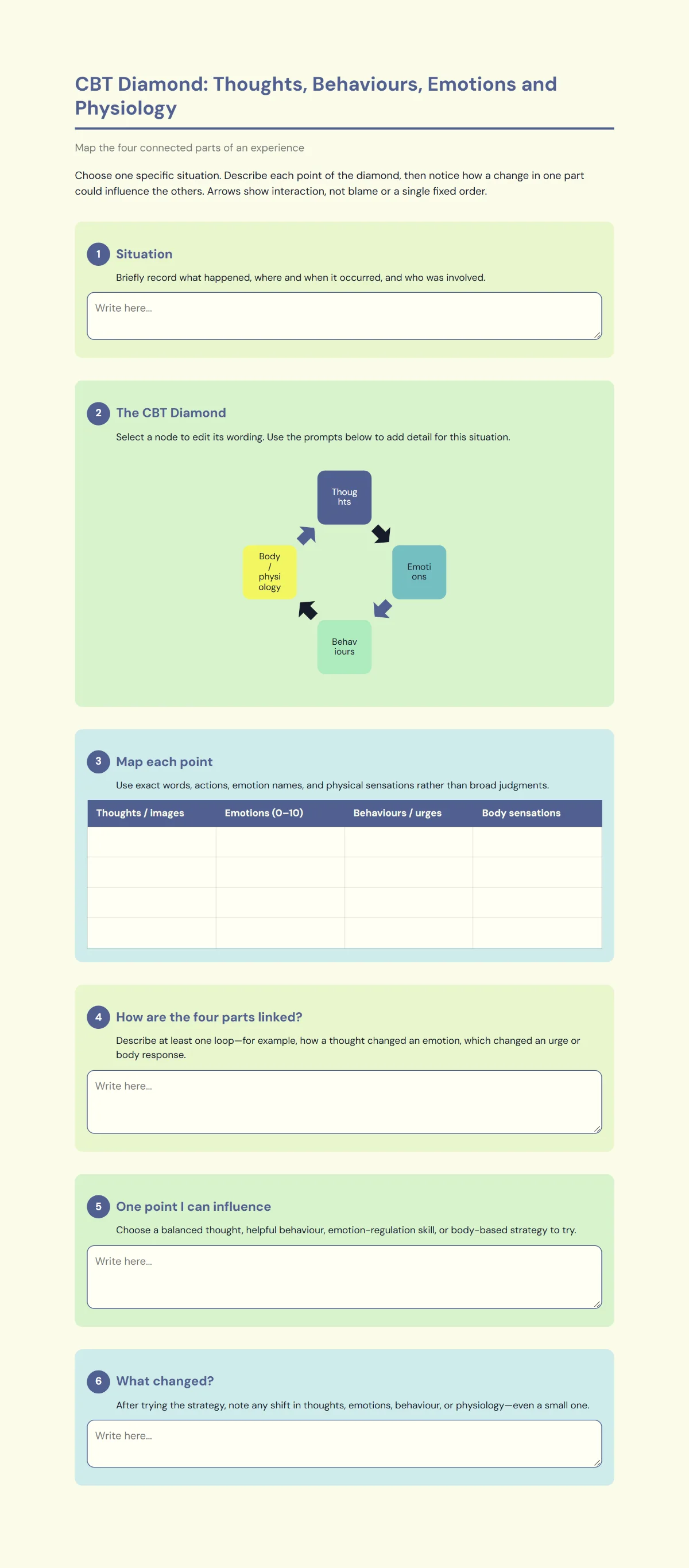
Cognitive behavioural therapy (CBT) rests on the idea that our emotional, behavioural and physical reactions are shaped by how we interpret a situation, not by the situation alone (Beck, 1976). Judith Beck’s cognitive model sets this out as a situation, an automatic thought and a reaction that is emotional, behavioural and physiological (J. S. Beck, 2020). The diamond simply draws those four parts as connected points.
You may have seen the same idea drawn differently. The CBT triangle, or cognitive triangle, links thoughts, feelings and behaviours. Padesky and Mooney’s five-part model, sometimes called the ‘hot cross bun’, adds physical reactions and places all four inside the person’s environment (Padesky & Mooney, 1990; Greenberger & Padesky, 2016). The Five Areas model used in UK services also adds life situation, relationships and practical problems (Williams & Garland, 2002). The worksheet’s situation box plays the role of that outer circle.
The arrows run in every direction. A thought can change a feeling, a body sensation can change a thought, and an action can change all three. That is why a change at any one point can help (Greenberger & Padesky, 2016).
The four points of the CBT diamond
Each point captures a different kind of information. Being specific at each one, using exact words, actions and sensations rather than broad judgements, makes the links easier to see (Greenberger & Padesky, 2016; Kuyken et al., 2009).
Thoughts
The words and images that go through your mind, including predictions and judgements. In the cognitive model these are the automatic thoughts that shape the other three points (J. S. Beck, 2020). Include images too, which tend to trigger stronger emotion than words (Holmes & Mathews, 2010).
- Examples
- “I’m going to make a fool of myself.” An image of people laughing.
- Ask yourself
- What was going through my mind? What was I afraid would happen?
Emotions
Feelings named in a single word, such as anxious, sad, angry, ashamed or guilty, with an intensity rating from 0 to 10 (Greenberger & Padesky, 2016). Naming feelings precisely is linked with better emotion regulation (Kashdan et al., 2015).
- Examples
- Anxious 8/10, embarrassed 6/10.
- Ask yourself
- What did I feel, and how strongly?
Behaviours and urges
What you did, or felt the urge to do, including what you avoided. Behaviour matters because it can keep a problem going: safety-seeking actions such as avoiding eye contact can prevent you from discovering that the feared outcome would not happen (Salkovskis, 1991).
- Examples
- Stayed at the back of the room, rehearsed what to say, left early.
- Ask yourself
- What did I do, avoid or feel like doing?
Body sensations
Physical changes such as a racing heart, tight chest, heat, tension or heaviness. Different emotions produce distinct and consistent patterns of bodily sensation (Nummenmaa et al., 2014), and misreading those sensations as dangerous can fuel anxiety, as in the cognitive model of panic (Clark, 1986).
- Examples
- Racing heart, hot face, shaky hands, knot in the stomach.
- Ask yourself
- What did I notice in my body?
CBT diamond examples
These two examples show the kind of loop the worksheet helps you find. In each, one point feeds another until the cycle keeps itself going (Kuyken et al., 2009).
Example 1: speaking up in a meeting
A social anxiety loop, where safety behaviours stop the fear from being tested (Salkovskis, 1991).
- Situation
- Monday team meeting. My manager asks for updates.
- Thoughts
- “I’ll stumble over my words and everyone will notice.”
- Emotions
- Anxious 8/10.
- Body
- Heart pounding, face hot, dry mouth.
- Behaviours
- Kept my update very short and avoided eye contact.
- The loop
- Noticing my hot face made me think ‘they can see I’m nervous’, which raised the anxiety. Keeping it short meant I never found out that people were barely paying attention.
- Point to influence
- Behaviour: give the full update next week and look at one friendly face.
Example 2: a low weekend
A low mood loop, where withdrawing from activity deepens the mood. Behavioural activation targets exactly this point (Ekers et al., 2014).
- Situation
- Saturday, nothing planned.
- Thoughts
- “There’s no point going out. I won’t enjoy it.”
- Emotions
- Sad 6/10, flat.
- Body
- Heavy, tired, slow.
- Behaviours
- Stayed in bed and scrolled on my phone until the afternoon.
- The loop
- Staying in bed made me feel more tired and flat, which seemed to confirm that going out would be pointless.
- Point to influence
- Behaviour: a 20-minute walk to the café before deciding how I feel.
How to use the CBT diamond worksheet
Choose one recent, specific situation rather than a general problem. The aim is to describe what happened clearly, see how the parts connect and pick one place to intervene (Greenberger & Padesky, 2016; Kuyken et al., 2009).
- Write a short, factual description of the situation: what happened, where, when and who was involved.
- Fill in each point of the diamond in the ‘Map each point’ table, using exact words, emotion names with a 0–10 rating, actions and physical sensations (Greenberger & Padesky, 2016).
- In ‘How are the four parts linked?’, describe at least one loop, for example how a thought changed a feeling, which changed what you did. The arrows show influence, not blame or a fixed order (Kuyken et al., 2009).
- Choose one point you can influence. That might be a balanced thought, a different action, an emotion-regulation skill or a body-based strategy such as slowing your breathing (Greenberger & Padesky, 2016).
- Try the strategy, then note in ‘What changed?’ any shift at any point, even a small one.
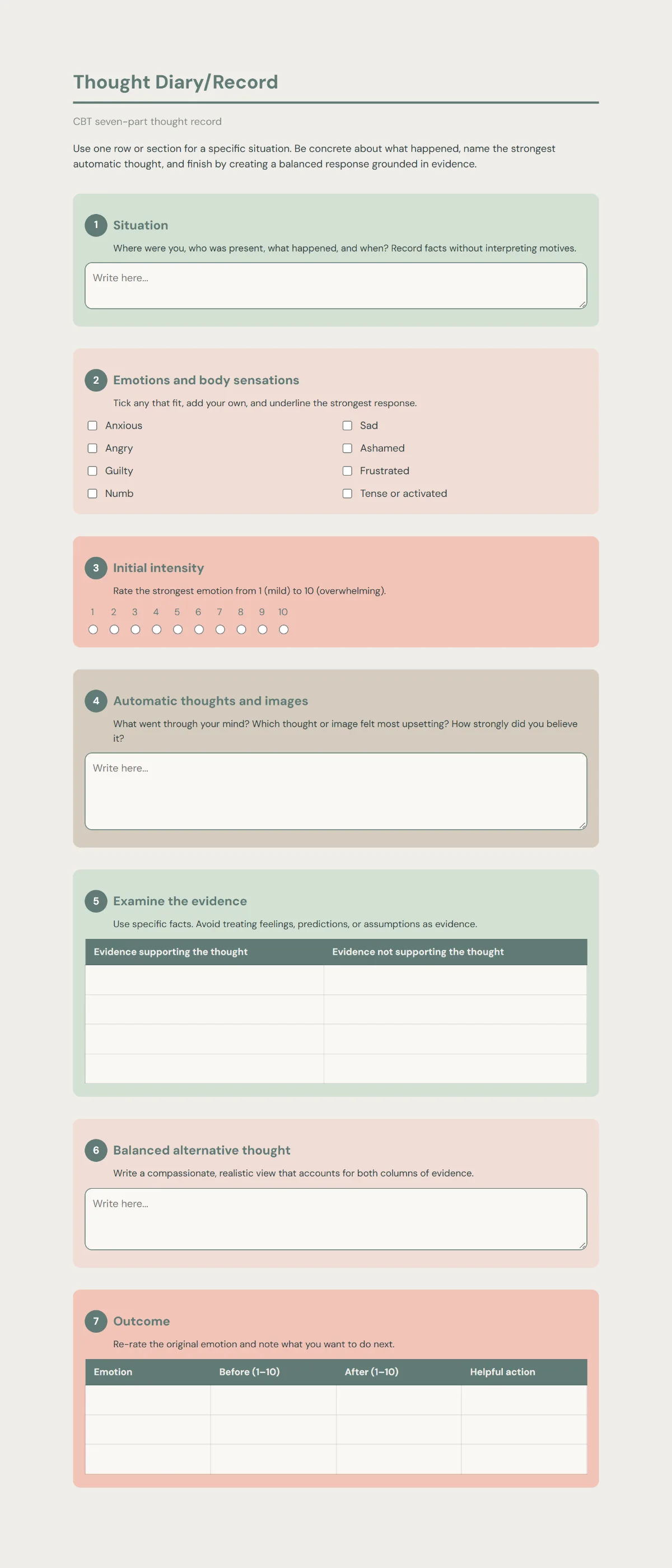
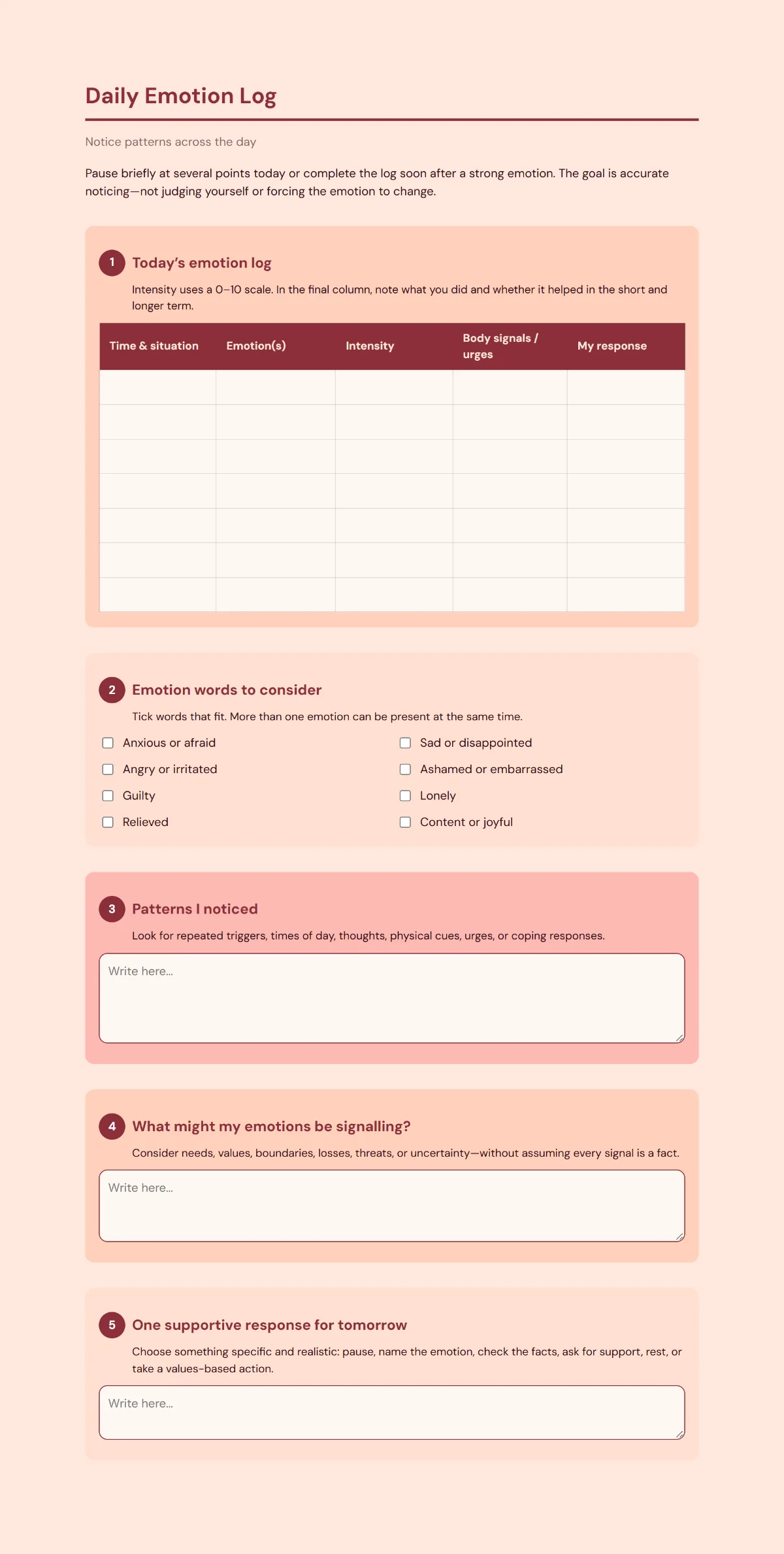
- To work on the thought point in more depth, use a thought record worksheet. To track the emotion and body points across a day, use the daily emotion log (Greenberger & Padesky, 2016).
Using the CBT diamond in therapy
The diamond is a quick, shared way to build a maintenance formulation early in therapy. Collaborative case conceptualisation starts from descriptions like this and builds towards an explanation of why a problem persists (Kuyken et al., 2009). The five-part model was designed specifically to make the cognitive model easy to present to clients (Padesky & Mooney, 1990).
Mapping a client’s own example tends to show several possible entry points. Cognitive methods target the thoughts corner; behavioural activation targets behaviour and has strong evidence in depression, with a meta-analysis of 26 trials finding it more effective than control conditions (Ekers et al., 2014); and panic treatment targets the loop between body sensations and catastrophic thoughts (Clark, 1986).
Because the worksheet is editable, you can rename a point to suit a client, for example ‘body’ instead of ‘physiology’, or add a fifth box for environment.
Does the CBT model help?
The diamond is a way of presenting the cognitive model, which underpins CBT. CBT has one of the broadest evidence bases in psychological therapy: a review of 269 meta-analyses found the strongest support in anxiety disorders, somatoform disorders, bulimia, anger control problems and general stress (Hofmann et al., 2012). NICE recommends CBT and behavioural activation among its treatments for depression in adults (NICE, 2022).
The value of the diamond is that it makes the model personal. Seeing your own loop can make it clearer why a strategy is worth trying, and practising between sessions is linked with better outcomes in CBT (Kazantzis et al., 2010).
Things to keep in mind
The diamond describes a moment; it does not explain everything. Life circumstances, relationships and practical problems also shape how people feel, which is why broader models include them (Williams & Garland, 2002).
Physical symptoms can have medical causes. If you notice new or worrying body sensations, check them with a doctor rather than assuming they are anxiety. If you are struggling, or having thoughts of harming yourself, speak with a GP, psychologist or other qualified professional.