What are cognitive distortions?
The idea comes from Aaron Beck’s early research on depression. Listening to his patients’ thoughts, Beck noticed systematic errors that tilted their conclusions in a negative direction, including arbitrary inference, selective abstraction, overgeneralisation, and magnification and minimisation (Beck, 1963). These errors became central to cognitive therapy, which treats them as habits of interpretation that can be noticed and tested, rather than as facts about the person (Beck et al., 1979).
The psychiatrist David Burns later popularised a list of ten distortions in everyday language, such as all-or-nothing thinking, mind reading and should statements (Burns, 1980). Researchers have since built questionnaires to measure them. The Cognitive Distortions Scale assesses ten patterns (Covin et al., 2011), and the Cognitive Distortions Questionnaire (CD-Quest) assesses fifteen, adding patterns such as blaming, ‘what if’ thinking and unfair comparisons (Kaplan et al., 2017).
Distortions are not unique to any diagnosis. Everyone has automatic thoughts, and some of them are distorted; CBT focuses on the ones that are linked to distress and get in the way of what matters to you (J. S. Beck, 2020). They do tend to be more common when mood is low: people with depression use more distorted thinking patterns in their social media posts than a random sample of users (Bathina et al., 2021).
List of cognitive distortions
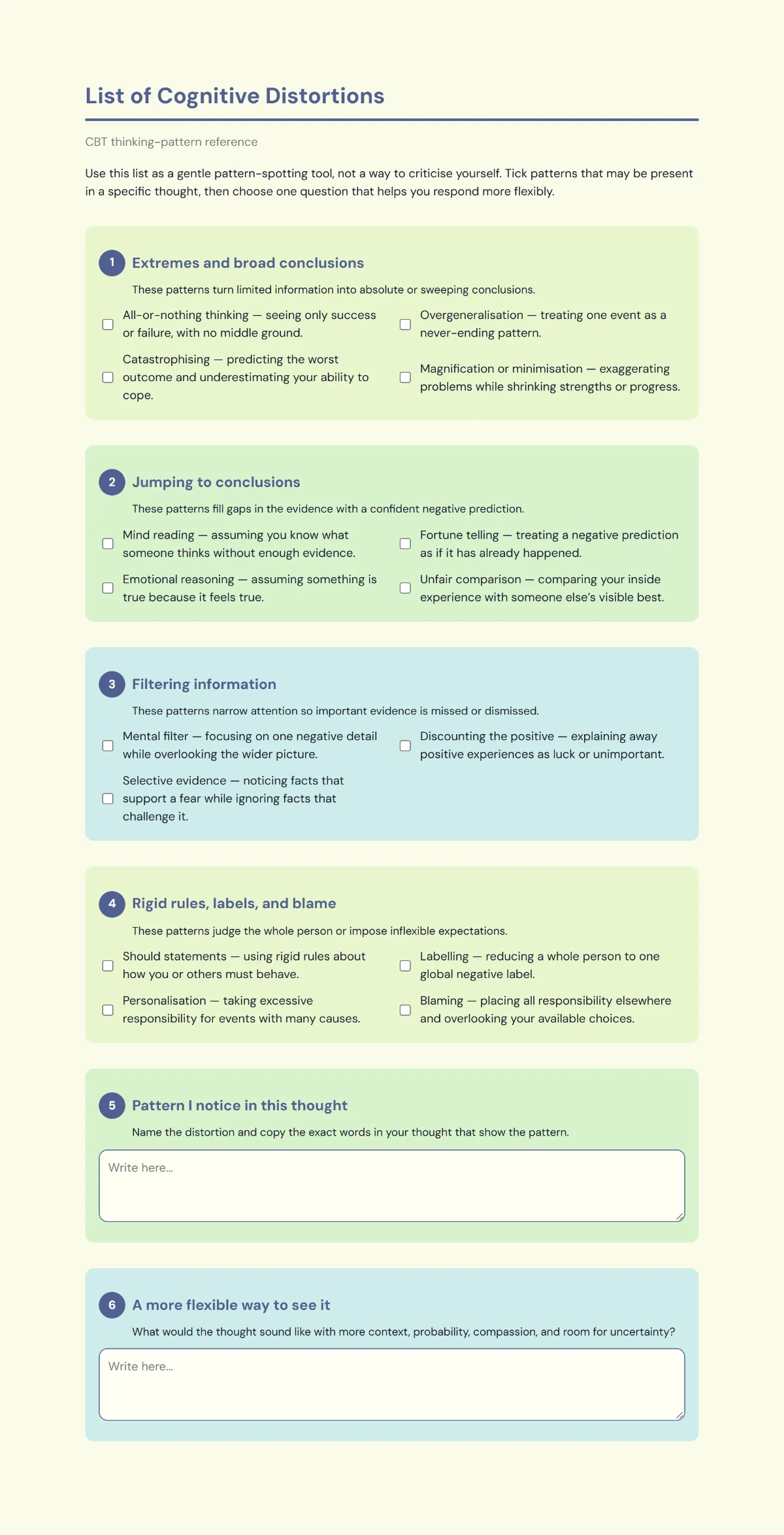
The worksheet groups 15 common cognitive distortions into four families: extremes and broad conclusions, jumping to conclusions, filtering information, and rigid rules, labels and blame. Most come from the lists used by Beck and Burns (Beck et al., 1979; Burns, 1980). Unfair comparison and blaming are items on the CD-Quest (Kaplan et al., 2017), and selective evidence describes confirmation bias, which is found across many kinds of everyday reasoning (Nickerson, 1998).
Each entry below gives a definition, an example thought and a question to test it. The questions follow the guided, Socratic style used in CBT, where you weigh the thought against the evidence rather than simply replacing it (J. S. Beck, 2020).
1. All-or-nothing thinking
Also called black-and-white or dichotomous thinking. You see a situation in only two categories, such as total success or complete failure, with no middle ground (Burns, 1980). Dichotomous thinking is closely linked with perfectionism (Egan et al., 2007).
- Example
- “I stumbled over one question, so the whole presentation was a disaster.”
- Question to ask
- Where does this sit on a scale from 0 to 100, rather than all or nothing?
2. Overgeneralisation
You draw a sweeping conclusion from a single event, often signalled by words like ‘always’ and ‘never’ (Beck, 1963; Burns, 1980). It resembles the global, stable explanations for bad events that attribution research links to depression (Abramson et al., 1978).
- Example
- “She didn’t reply. People always lose interest in me.”
- Question to ask
- Is this one event, or does the evidence really show the same thing every time?
3. Catastrophising
Also spelled catastrophizing. You predict the worst possible outcome, treat it as likely and underestimate your ability to cope. Burns describes it as a form of magnification (Burns, 1980). Research on pain catastrophising identifies three parts: rumination, magnification and helplessness (Sullivan et al., 1995).
- Example
- “This headache means something is seriously wrong, and I won’t be able to handle it.”
- Question to ask
- What is the most likely outcome, and how have I coped with hard things before?
4. Magnification and minimisation
You blow mistakes and problems out of proportion while shrinking your strengths and progress (Beck, 1963; Burns, 1980).
- Example
- “My mistake in the meeting was humiliating. Finishing the project early doesn’t count.”
- Question to ask
- How would I weigh these two things if a friend described them to me?
5. Mind reading
You assume you know what someone else is thinking, usually something negative about you, without enough evidence (Burns, 1980). It is prominent in social anxiety, where people build a mental picture of how they appear to others and treat it as accurate (Rapee & Heimberg, 1997).
- Example
- “They went quiet when I spoke. They think I’m boring.”
- Question to ask
- What else could explain their reaction, and how could I find out?
6. Fortune telling
You treat a negative prediction as if it were already a fact (Burns, 1980). People with more depressive symptoms tend to make unrealistically negative predictions about future life events (Strunk et al., 2006).
- Example
- “I won’t get the job, so there’s no point applying.”
- Question to ask
- What happened the last few times I predicted this, and what other outcomes are possible?
7. Emotional reasoning
You assume something is true because it feels true (Burns, 1980). In one experiment, people with anxiety disorders rated scenarios as more dangerous when the scenario included their own anxious response, even when it was objectively safe (Arntz et al., 1995).
- Example
- “I feel like a burden, so I must be one.”
- Question to ask
- What would I conclude from the facts alone, if I set the feeling aside?
8. Unfair comparison
You compare yourself with others in a way that is stacked against you, such as measuring your inside experience against someone else’s visible best (Kaplan et al., 2017). People have a basic drive to evaluate themselves against others (Festinger, 1954), which is why the choice of comparison matters.
- Example
- “Everyone else my age has their life together.”
- Question to ask
- Am I comparing like with like, and what don’t I know about their situation?
9. Mental filter
Also called selective abstraction. You pick out a single negative detail and dwell on it until the whole situation looks negative (Beck, 1963; Burns, 1980). Anxiety and depression are associated with biases in attention, interpretation and memory that favour negative information (Mathews & MacLeod, 2005).
- Example
- “Most of the feedback was positive, but one person said my slides were cluttered, so it went badly.”
- Question to ask
- What am I leaving out of the picture?
10. Discounting the positive
You reject positive experiences by insisting they don’t count, for example by putting a success down to luck (Burns, 1980). A related habit, dampening positive feelings, is associated with depressive symptoms (Feldman et al., 2008).
- Example
- “They only said it went well to be nice.”
- Question to ask
- If this had gone badly, would I count it? Why not count it when it went well?
11. Selective evidence
You notice facts that support a fear while overlooking facts that challenge it. This is a form of confirmation bias, the well-documented tendency to seek out and favour evidence that fits an existing belief (Nickerson, 1998). In anxiety, attention is also drawn more readily towards threat (Bar-Haim et al., 2007).
- Example
- “I searched my symptoms and found three pages that match the worst diagnosis.”
- Question to ask
- What evidence would I expect to see if the belief were not true, and have I looked for it?
12. Should statements
You hold rigid rules about how you or other people must behave, expressed as ‘should’, ‘must’ or ‘ought’ (Burns, 1980). Albert Ellis described these absolute demands as a core source of emotional disturbance (Ellis, 1962).
- Example
- “I should be able to handle this without asking for help.”
- Question to ask
- What changes if I say ‘I’d prefer’ instead of ‘I should’?
13. Labelling
You attach a global negative label to yourself or someone else because of one behaviour, such as ‘I’m a failure’ instead of ‘I made a mistake’ (Burns, 1980). Labelling is one of the ten patterns measured by the Cognitive Distortions Scale (Covin et al., 2011).
- Example
- “I forgot her birthday. I’m a terrible friend.”
- Question to ask
- Does one action define a whole person?
14. Personalisation
You take excessive responsibility for events that have many causes, or assume other people’s behaviour is about you (Beck et al., 1979; Burns, 1980). It mirrors the internal explanations for bad events that attribution research links to lowered self-esteem in depression (Abramson et al., 1978).
- Example
- “My son failed his test because I’m a bad parent.”
- Question to ask
- What other factors played a part, and what share is realistically mine?
15. Blaming
You place all responsibility on other people or circumstances and overlook the choices you still have. The CD-Quest measures blaming of others or oneself as a distinct distortion (Kaplan et al., 2017).
- Example
- “My partner ruined the evening, so there’s nothing I can do about how I feel.”
- Question to ask
- Which part of this is within my control?
Cognitive distortions examples
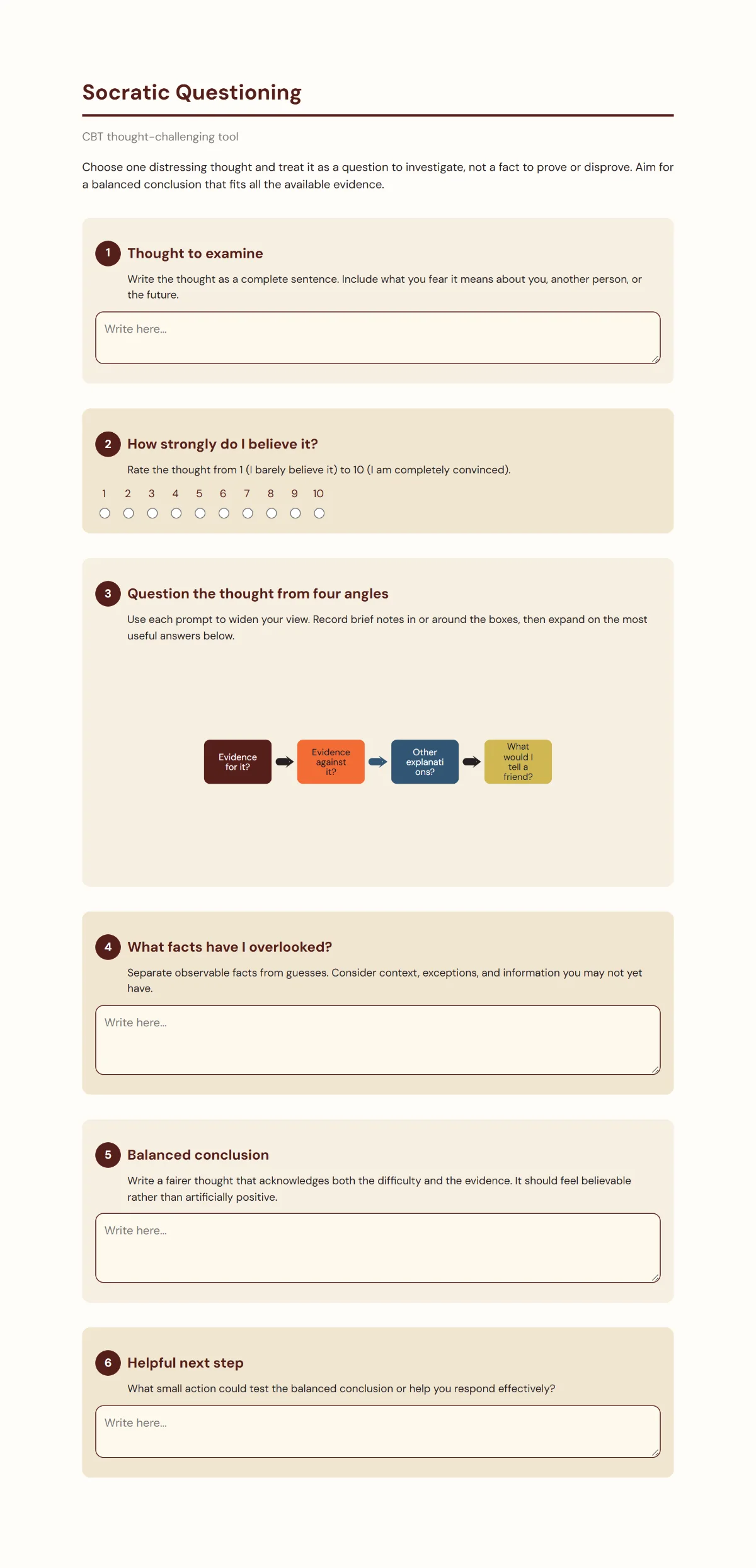
These two worked examples follow the cognitive restructuring sequence used in CBT: notice the automatic thought, name the patterns in it, weigh the evidence and write a more balanced response (J. S. Beck, 2020). A single thought often contains more than one distortion (Burns, 1980).
Example 1: an unanswered message
A common social worry, where mind reading and overgeneralisation feed each other (Rapee & Heimberg, 1997; Burns, 1980).
- Situation
- Maya messages a friend in the morning and has no reply by evening.
- Thought
- “She’s annoyed with me. I always mess up friendships.”
- Patterns
- Mind reading (“she’s annoyed”), overgeneralisation (“always”).
- More flexible thought
- “I don’t know why she hasn’t replied. She’s often busy on weeknights, and we had a good catch-up last week. I can check in tomorrow.”
Example 2: feedback at work
A performance worry, where all-or-nothing thinking and labelling turn a routine request into a verdict on the person (Burns, 1980; Egan et al., 2007).
- Situation
- Sam’s manager asks for changes to two sections of a report.
- Thought
- “The report is useless. I’m hopeless at this job.”
- Patterns
- All-or-nothing thinking (“useless”), labelling (“hopeless”), mental filter (ignoring the praise for the analysis).
- More flexible thought
- “Two sections need work, and my manager said the analysis was strong. Revisions are a normal part of writing a report.”
How to use the cognitive distortions worksheet
Work through one thought at a time. Choose a recent, specific moment when your mood shifted, because thoughts are easier to catch while the situation is still fresh (J. S. Beck, 2020).
- Write down the situation and the thought in the words that went through your mind. If you notice a strong feeling first, ask yourself, ‘What was going through my mind just then?’ (J. S. Beck, 2020)
- Read through the list and tick any patterns that might be present. More than one may apply (Burns, 1980).
- In ‘Pattern I notice in this thought’, name the distortion and copy the exact words that show it, such as ‘always’, ‘should’ or ‘everyone’.
- Ask the question listed for that distortion above, and weigh the evidence for and against the thought (J. S. Beck, 2020).
- Write a more flexible version in ‘A more flexible way to see it’. Aim for a thought that is accurate and useful, not one that is forced to be positive (J. S. Beck, 2020).
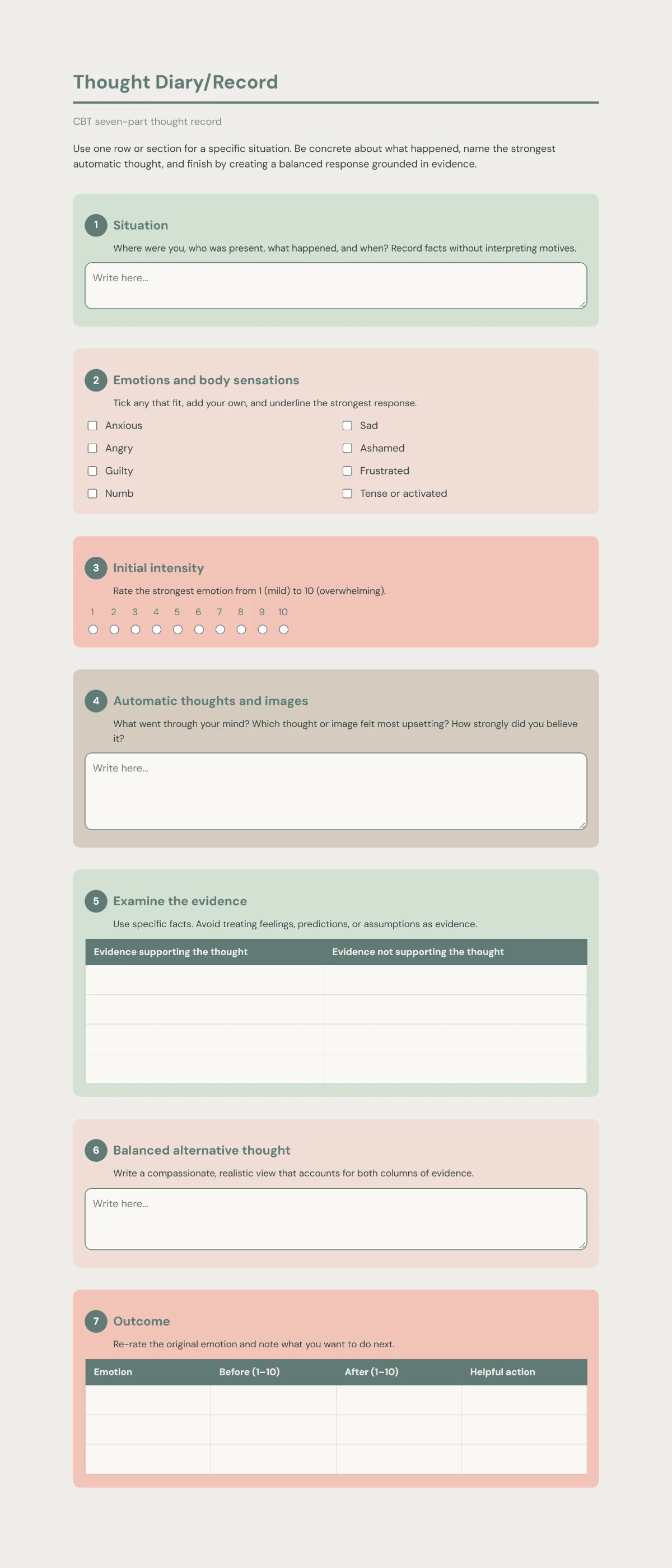
- Notice how strongly you now believe the original thought. If it still feels true, a thought record worksheet or a Socratic questioning worksheet can take the evidence further.
Using the worksheet in therapy
Clinicians can introduce the list in session as psychoeducation, then set the worksheet as between-session practice. Across studies, completing homework in cognitive and behavioural therapy is associated with better treatment outcomes (Kazantzis et al., 2010).
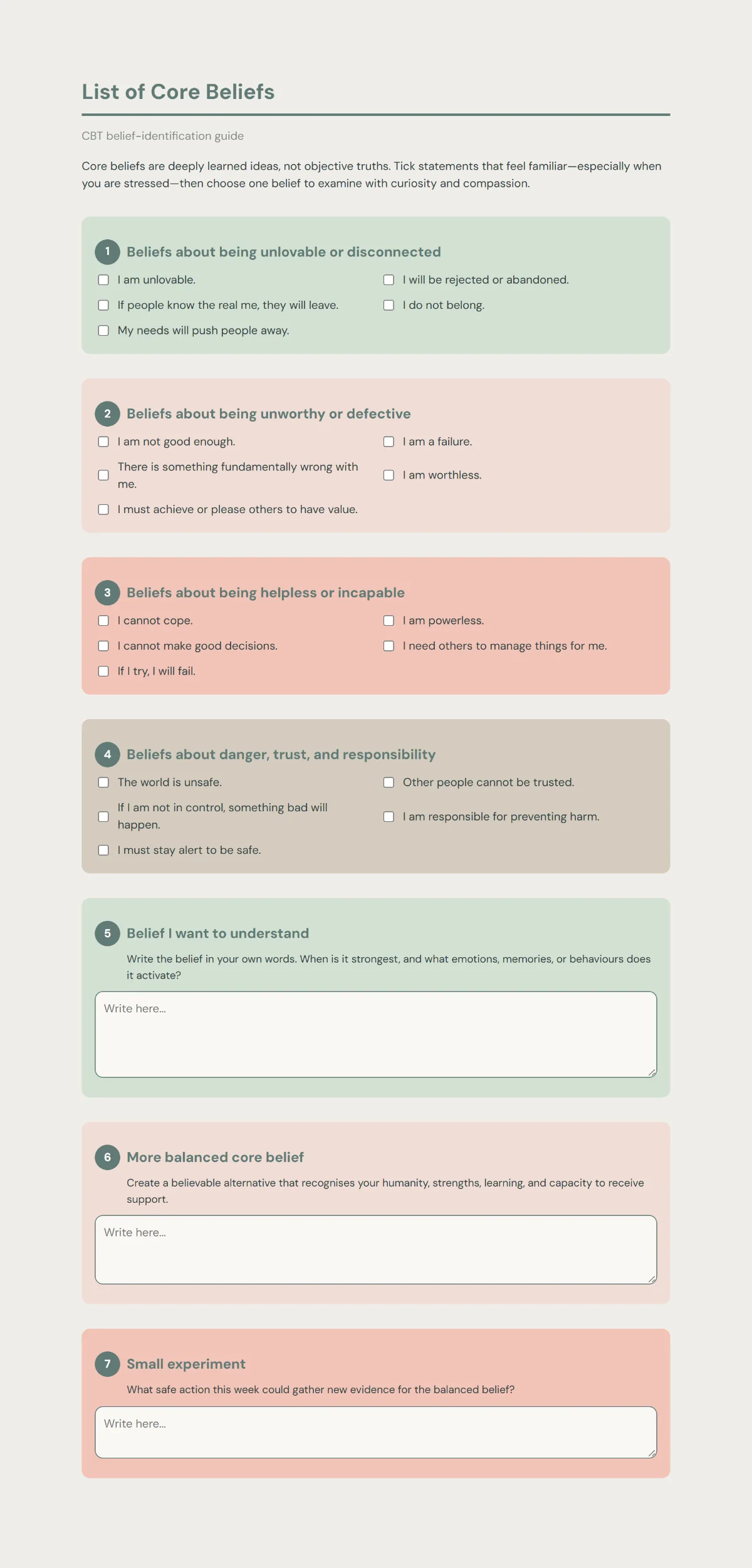
The questions work best when the client does the discovering. Therapists’ use of Socratic questioning has been found to predict session-to-session symptom improvement in cognitive therapy for depression (Braun et al., 2015). When the same distortion keeps recurring, it may point to an underlying belief that is worth exploring with a core beliefs worksheet (J. S. Beck, 2020).
The worksheet is editable, so you can shorten the list to the patterns a client recognises, adjust the wording for a younger reader or add examples from their own week.
Does identifying cognitive distortions help?
Identifying and restructuring distorted thoughts is a core part of CBT, which has one of the broadest evidence bases in psychotherapy. A review of 269 meta-analyses found the strongest support for CBT in anxiety disorders, somatoform disorders, bulimia, anger control problems and general stress (Hofmann et al., 2012). In the UK, the National Institute for Health and Care Excellence (NICE) includes CBT among its recommended treatments for depression in adults (NICE, 2022).
How much of that benefit comes from changing thoughts specifically is still being studied. A detailed review concluded that cognitive procedures do relieve symptoms of depression and that cognitive change contributes to improvement, while setting out the methodological limits of the research so far (Lorenzo-Luaces et al., 2015).
For anxiety, cognitive models aim to move people from fast, automatic threat responses towards slower, more reflective thinking (Beck & Clark, 1997). Pausing to name a pattern and weigh the evidence is practice in exactly that shift.
What cognitive distortions are not
Spotting a distortion does not prove a thought is wrong. Some negative thoughts are accurate, and CBT treats those as problems to solve rather than thoughts to argue away (J. S. Beck, 2020).
The list is a tool for understanding, not a diagnosis or a judgement of character. If distressing thoughts are frequent or intense, or include thoughts of harming yourself, speak with a GP, psychologist or other qualified professional.