What is DEAR MAN in DBT?
DBT teaches skills in four modules: mindfulness, distress tolerance, emotion regulation and interpersonal effectiveness (Linehan, 2015). The interpersonal effectiveness module recognises three goals in any difficult conversation: getting what you want (your objective), keeping the relationship, and keeping your self-respect. DEAR MAN is the skill for the first of these, with GIVE for the relationship and FAST for self-respect (Linehan, 2015).
In practice, DEAR MAN is a structured form of assertive communication. Assertiveness training was one of the earliest behavioural treatments, and reviewers have argued that it is an evidence-based approach that deserves more attention than it now gets (Speed et al., 2018).
Asking for what you need matters beyond the single conversation. Across 148 studies, people with stronger social relationships had a 50% greater likelihood of survival over the study periods (Holt-Lunstad et al., 2010). Being able to make requests and set limits is part of keeping those relationships working.
The DEAR MAN steps
The first four letters are what you say, in roughly this order. The last three are how you say it (Linehan, 2015). Most requests need only a sentence or two for each.
D — Describe
Start with the facts of the situation, as a neutral observer would see them. Leaving out judgements and blame makes it less likely the other person gets defensive before hearing your request (Linehan, 2015).
- Example
- “The dishes have been in the sink since Sunday, and I’ve cleaned the kitchen the last three weekends.”
- Tip
- If you catch words like ‘always’, ‘never’ or ‘lazy’, you have moved from describing into judging.
E — Express
Say how you feel or what you think about the situation, using ‘I’ statements (Linehan, 2015). Expressing feelings, rather than holding them in, matters for relationships: people who habitually suppress their emotions report worse interpersonal functioning (Gross & John, 2003).
- Example
- “I feel frustrated and a bit taken for granted.”
- Tip
- Keep it short. One or two feelings is enough.
A — Assert
Ask clearly for what you want, or say no clearly. Don’t hint or expect the other person to work it out (Linehan, 2015). Direct, specific requests are at the heart of assertiveness training (Speed et al., 2018).
- Example
- “Could we set up a cleaning roster, starting this week?”
- Tip
- A request the other person can say yes to (“Could we…”) is usually easier to hear than a demand.
R — Reinforce
Explain the benefits of agreeing, or show appreciation when the person does. People are more likely to agree to requests that work for them too (Linehan, 2015).
- Example
- “It would mean neither of us has to think about it, and I’d stop nagging.”
- Tip
- Say thank you afterwards if they agree. That reinforces it for next time.
M — (stay) Mindful
Keep your attention on your goal. If the other person changes the subject or goes on the attack, calmly repeat your request rather than getting drawn into a side argument (Linehan, 2015).
- Example
- “I hear that work has been busy. I’d still like us to agree on a roster.”
- Tip
- Repeating your point calmly, several times if needed, is sometimes called the ‘broken record’.
A — Appear confident
Use a steady voice, make eye contact and stand or sit upright, even if you don’t feel confident inside (Linehan, 2015). Non-verbal behaviour is a standard focus of assertiveness training (Speed et al., 2018).
- Example
- Speaking at a normal pace instead of apologising or trailing off.
- Tip
- Practise out loud beforehand, or in front of a mirror.
N — Negotiate
Be willing to give to get. Offer alternatives, or turn the problem over to the other person and ask what they would suggest (Linehan, 2015). Negotiation research suggests focusing on the interests behind each side’s position and looking for options that work for both (Fisher & Ury, 1981).
- Example
- “If a roster doesn’t suit you, what would work instead?”
- Tip
- Decide in advance where you can bend and where you can’t. The goals table on the worksheet helps with this.
DEAR MAN examples
These two worked examples show a request and a refusal. Notice that each part is short and specific (Linehan, 2015).
Example 1: asking a flatmate to share the cleaning
A request where both the outcome and the relationship matter (Linehan, 2015).
- Describe
- “The dishes have been in the sink since Sunday, and I’ve cleaned the kitchen the last three weekends.”
- Express
- “I feel frustrated and a bit taken for granted.”
- Assert
- “Could we set up a cleaning roster, starting this week?”
- Reinforce
- “It would mean neither of us has to think about it, and I’d stop nagging.”
- Mindful
- If they bring up something I did, come back to the roster.
- Appear confident
- Have the conversation sitting down, not while passing in the hallway.
- Negotiate
- “If a roster doesn’t suit you, what would?”
Example 2: saying no to extra work
A refusal, where keeping self-respect and a good working relationship both matter (Linehan, 2015; Speed et al., 2018).
- Describe
- “You’ve asked me to take on the new report by Friday. I’m already working on two deadlines this week.”
- Express
- “I’m worried the quality of all three would suffer.”
- Assert
- “I can’t take it on this week. I could start it on Monday.”
- Reinforce
- “That way you’ll get a report I’ve had time to do properly.”
- Mindful
- If pushed, repeat: “I can start it on Monday.”
- Appear confident
- No over-apologising or long explanations.
- Negotiate
- “If it has to be this week, which of my other tasks could move?”
How to use the DEAR MAN worksheet
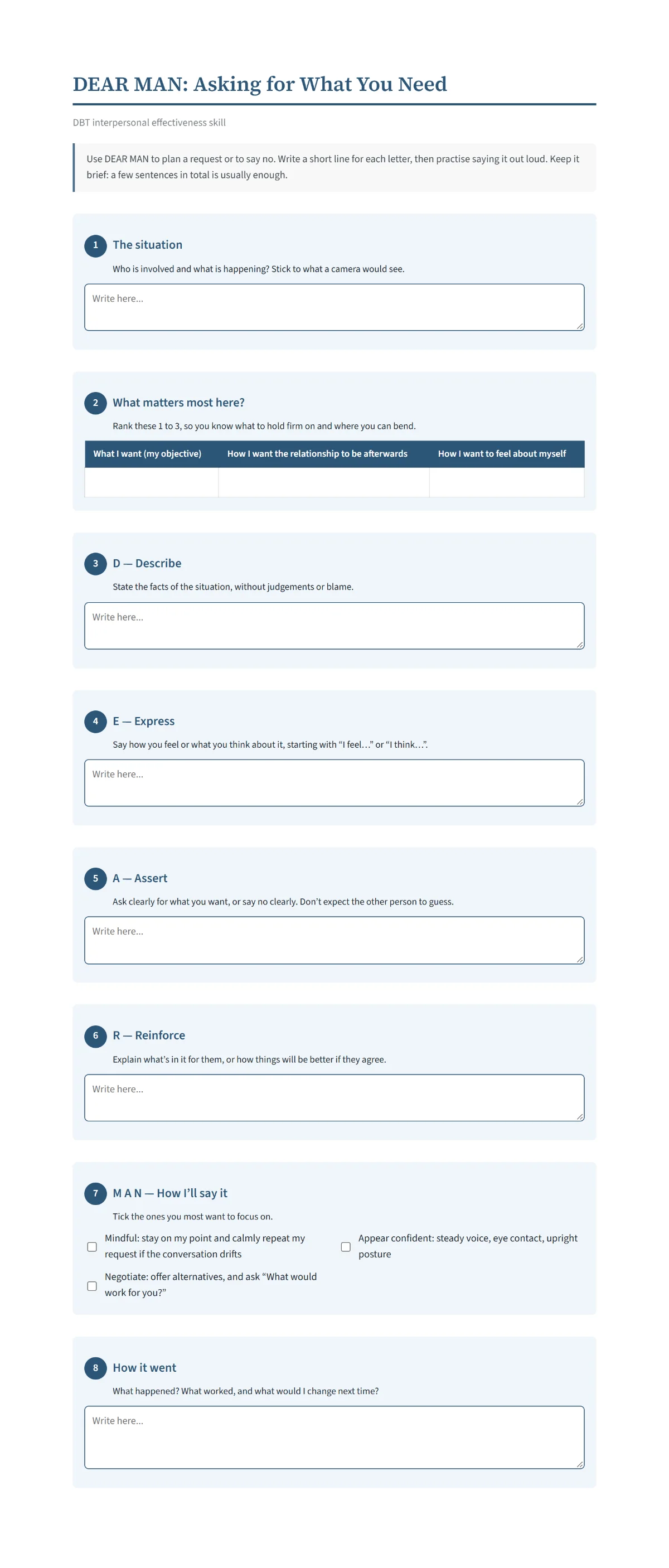
Plan the conversation before you have it. Writing a script and rehearsing it out loud is a core part of assertiveness training, and it makes the words easier to find under pressure (Speed et al., 2018).
- Describe the situation in facts only: who, what and when.
- In ‘What matters most here?’, note what you want, how you want the relationship to be afterwards and how you want to feel about yourself, and rank them 1 to 3. This tells you how hard to push (Linehan, 2015).
- Write one or two sentences for each of Describe, Express, Assert and Reinforce.
- Tick the parts of MAN you most need to remember, and plan what you’ll offer if you need to negotiate.
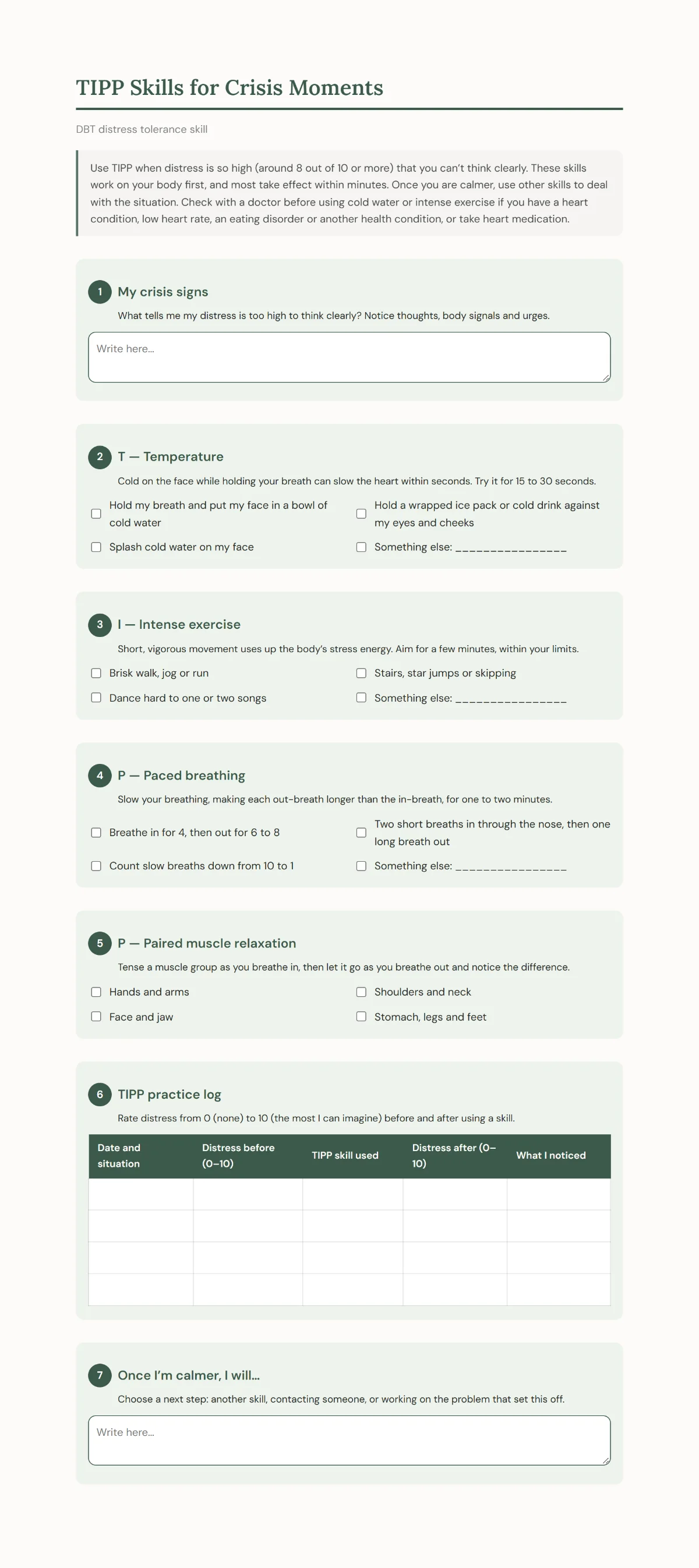
- Practise out loud, ideally with someone you trust. If you are too upset to think clearly beforehand, use a calming skill such as TIPP first (Linehan, 2015).
- Afterwards, fill in ‘How it went’. Look at what worked, not only whether you got what you asked for.
Using DEAR MAN in therapy
DEAR MAN lends itself to role-play. Clients can script a real upcoming conversation, rehearse it with the therapist playing the other person, and then practise the ‘broken record’ when the therapist pushes back (Linehan, 2015; Speed et al., 2018).
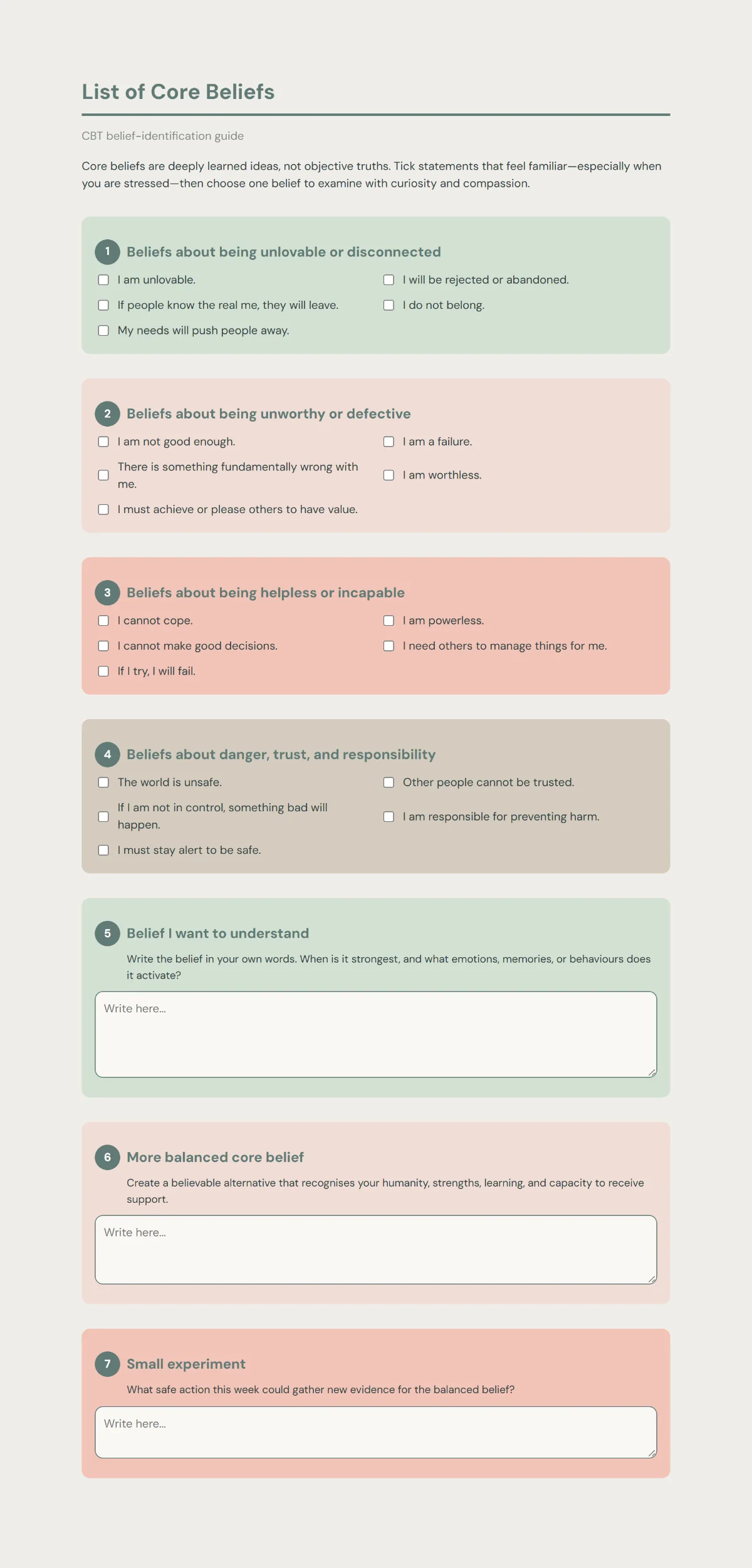
When clients find it hard to ask for anything at all, the barrier is often a belief such as ‘My needs will push people away’ or ‘I don’t deserve to ask’. Working on it with a core beliefs worksheet can make the skill easier to use (J. S. Beck, 2020).
DBT skills use appears to be an active ingredient of treatment: in an analysis of DBT trials, increases in skills use fully accounted for reductions in suicide attempts and depression and for improved control of anger (Neacsiu et al., 2010).
Does DEAR MAN work?
DEAR MAN has not been tested on its own in a clinical trial. Its components come from assertiveness training, which reviewers describe as an evidence-based treatment (Speed et al., 2018), and it is part of DBT, which has good evidence overall. A randomised trial found DBT roughly halved suicide attempts compared with treatment by community experts (Linehan et al., 2006), and a Cochrane review found improvements in borderline symptoms compared with usual care, though with low-certainty evidence (Storebø et al., 2020).
DBT skills training is also used on its own. Early studies suggest benefits for a range of problems, but the evidence is still preliminary (Valentine et al., 2015). In one small randomised trial with anxious or depressed adults, skills training reduced emotion dysregulation more than a support group did (Neacsiu et al., 2014).