What is the TIPP skill in DBT?
DBT was developed by Marsha Linehan as a treatment for people with intense, hard-to-manage emotions, originally for chronically suicidal people with borderline personality disorder (Linehan, 1993). Its skills are taught in four modules: mindfulness, distress tolerance, emotion regulation and interpersonal effectiveness. TIPP belongs to distress tolerance, the group of skills for getting through a crisis without making it worse (Linehan, 2015).
The idea behind TIPP is that at very high levels of arousal, thinking skills are hard to use. Research on stress supports this: even fairly mild, uncontrollable stress can quickly impair the prefrontal cortex, the part of the brain that handles planning and flexible thinking (Arnsten, 2009). TIPP aims to bring the body’s arousal down first, so that other skills become usable again.
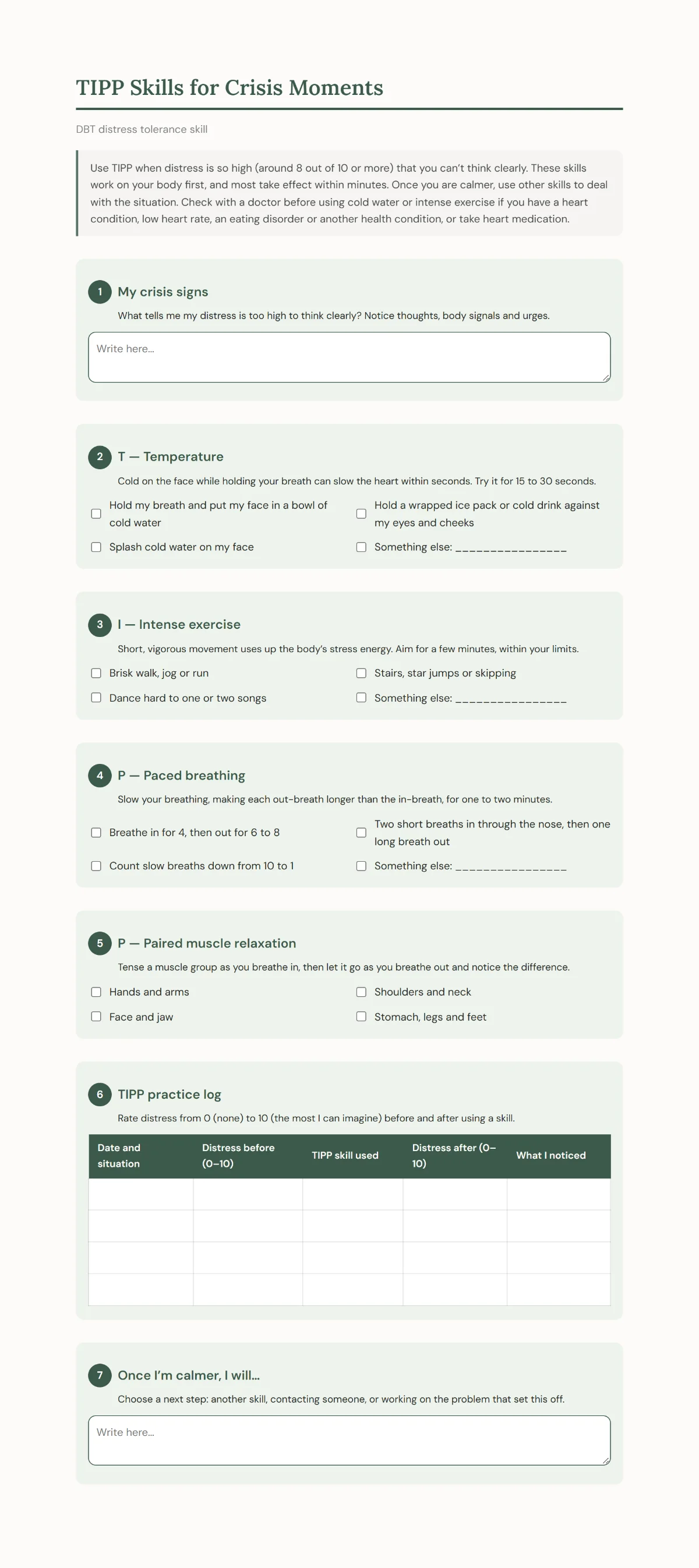
The four letters stand for Temperature, Intense exercise, Paced breathing and Paired muscle relaxation (Linehan, 2015). They are meant for short-term relief in a crisis, not as a way of avoiding feelings in general.
The four TIPP skills
Each skill acts on the body in a different way. Most people find one or two that suit them best, which is why the worksheet asks you to choose and practise your own versions (Linehan, 2015).
T — Temperature
Cooling the face, especially while holding your breath, triggers the dive reflex, a built-in response that slows the heart (Hurwitz & Furedy, 1986). In a laboratory study, cold packs on the face slowed the heart within seconds, with the largest effect at around half a minute (Khurana & Wu, 2006).
- How to do it
- Hold your breath and put your face in a bowl of cold water for 15 to 30 seconds, or hold a wrapped ice pack or cold drink against your eyes and cheeks.
- Why it helps
- It is one of the fastest ways to bring physical arousal down, which is why it often comes first in a crisis (Linehan, 2015).
I — Intense exercise
A short burst of vigorous movement uses up the energy the body has mobilised for fight or flight. A meta-analysis of 36 randomised trials found that a single bout of exercise produces a small but reliable reduction in anxiety (Ensari et al., 2015).
- How to do it
- Run, walk fast, climb stairs, do star jumps or dance hard for a few minutes, within the limits of your health and fitness.
- Why it helps
- It gives strong feelings a physical outlet that doesn’t cause harm, and it changes your body state quickly (Linehan, 2015).
P — Paced breathing
Deliberately slowing your breathing changes how the nervous system responds. A systematic review found that slow breathing increases heart rate variability, a marker of calmer autonomic activity (Zaccaro et al., 2018). In a randomised study, five minutes a day of breathing with long out-breaths improved mood and lowered breathing rate more than mindfulness meditation did (Balban et al., 2023).
- How to do it
- Breathe in for about 4 counts and out for 6 to 8, for one to two minutes. Another option is two short breaths in through the nose followed by one long breath out.
- Why it helps
- It can be done anywhere, without anyone noticing, which makes it useful in public or at work.
P — Paired muscle relaxation
Tensing a group of muscles and then releasing them on the out-breath pairs physical relaxation with slow breathing (Linehan, 2015). It is related to progressive muscle relaxation, and a meta-analysis found that relaxation training has a medium-to-large effect on anxiety (Manzoni et al., 2008).
- How to do it
- Breathe in and tense one muscle group (hands, shoulders, face or legs) for about five seconds, then breathe out, let go completely and notice the difference. Move through several groups.
- Why it helps
- Noticing the contrast between tension and release makes it easier to recognise and let go of tension later.
TIPP skill examples
These examples show how TIPP fits into a real moment. In both, the aim is to bring distress down enough to use other skills, not to solve the problem on the spot (Linehan, 2015).
Example 1: after an argument
Anger at a very high level, with an urge to send a message that would make things worse (Linehan, 2015).
- Crisis signs
- Heart pounding, face hot, typing an angry reply. Distress 9/10.
- Skill used
- Temperature: cold water on the face for 30 seconds, twice.
- Distress after
- 6/10.
- Next step
- Deleted the draft reply, went for a fast walk and decided to talk tomorrow using DEAR MAN.
Example 2: overwhelming anxiety at work
Anxiety rising before a meeting, where leaving the building is not an option. Discreet skills work best here (Balban et al., 2023; Manzoni et al., 2008).
- Crisis signs
- Tight chest, shaky hands, can’t follow what people are saying. Distress 8/10.
- Skill used
- Paced breathing at my desk for two minutes, then paired muscle relaxation for hands and shoulders.
- Distress after
- 5/10.
- Next step
- Wrote down the one point I needed to make in the meeting.
How to use the TIPP skills worksheet
Fill in most of the worksheet when you are calm. Skills are much easier to use in a crisis if you have already practised them, which is why DBT asks people to rehearse skills before they need them (Linehan, 2015).
- In ‘My crisis signs’, list the thoughts, body signals and urges that tell you distress is too high to think clearly, for example 8 out of 10 or more.
- Read the safety note in the instructions. If any of it applies to you, check with a doctor before using cold water or intense exercise (Khurana & Wu, 2006).
- Tick the versions of each skill you are willing to try, and add your own ideas.
- Practise each one at least once when you are only mildly upset, so you know what it feels like (Linehan, 2015).
- When a crisis comes, use a skill for a few minutes and rate your distress before and after in the practice log.
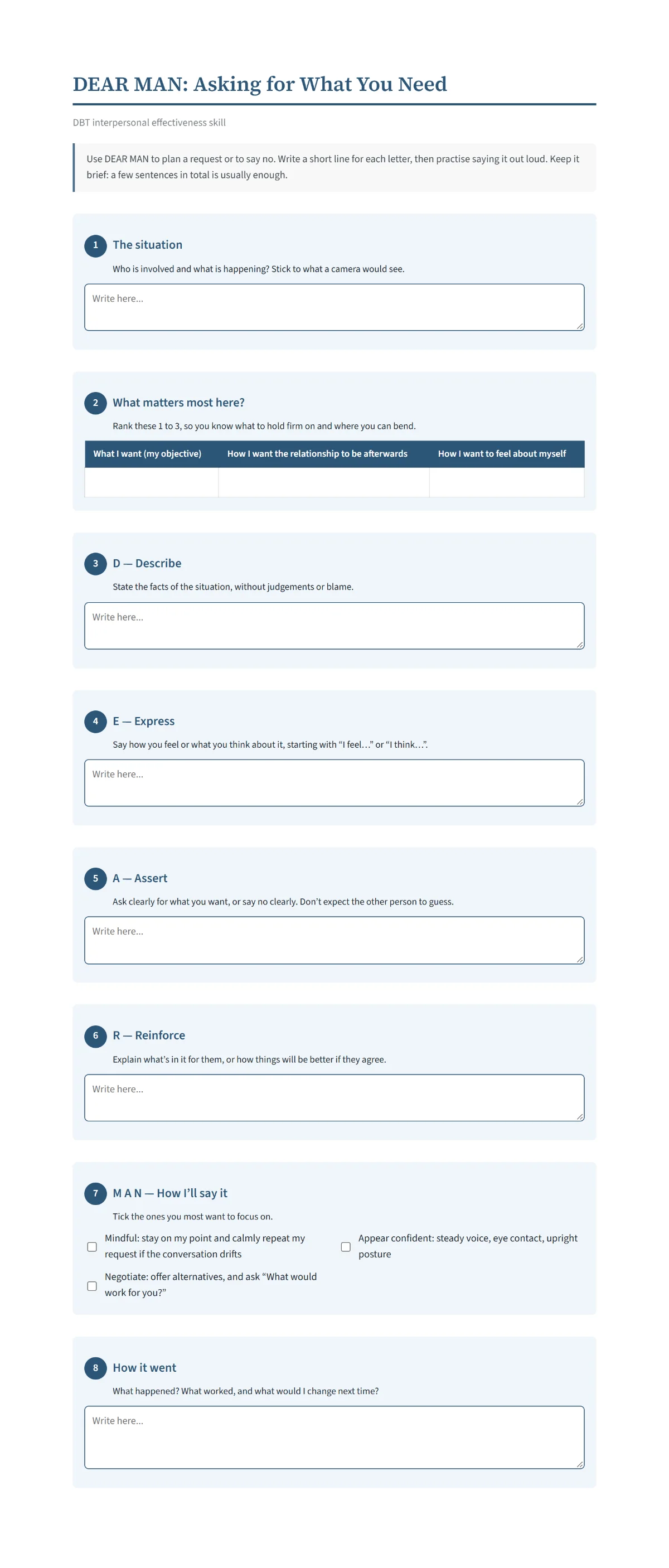
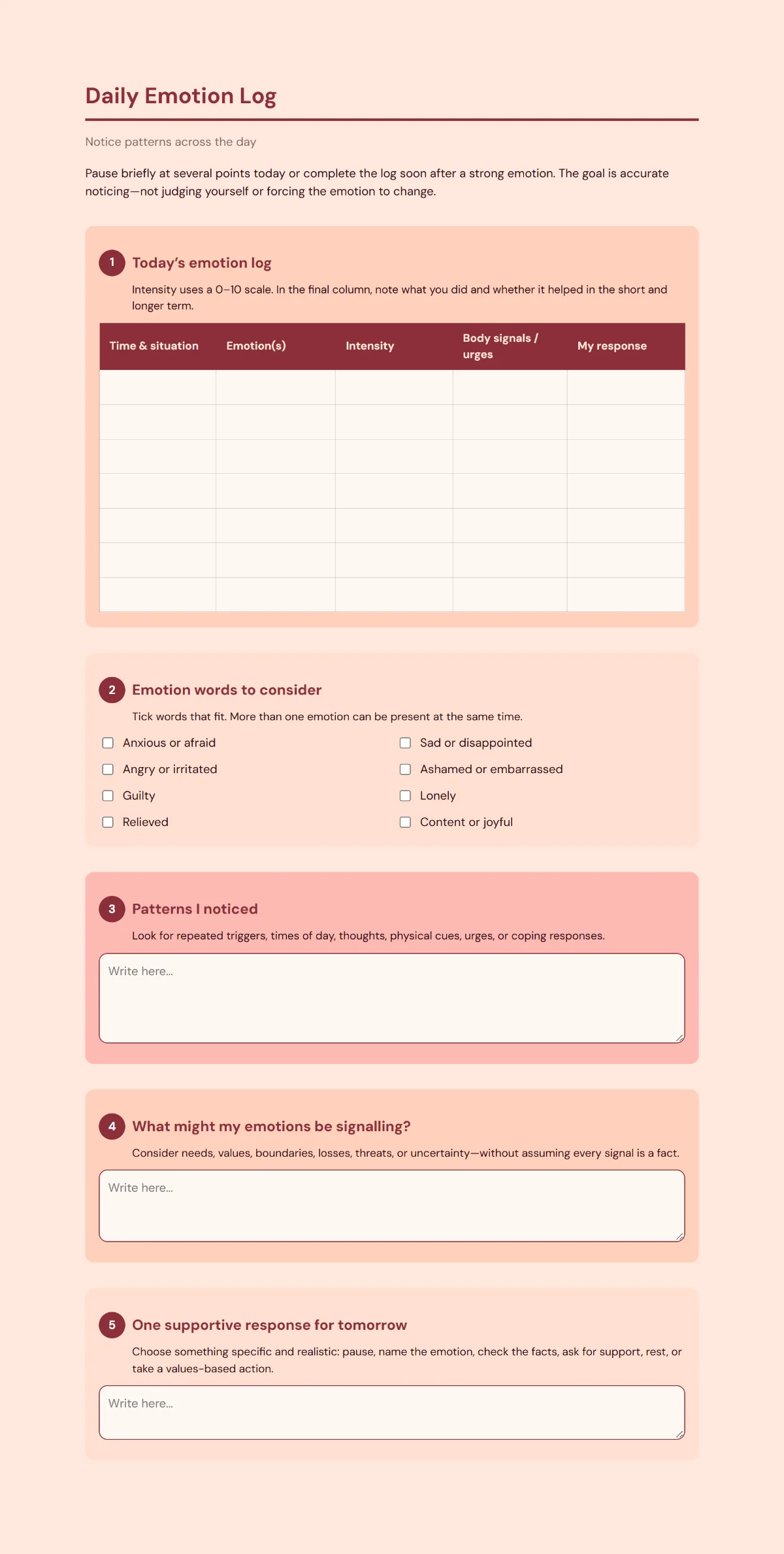
- Once you are calmer, move to the step you wrote in ‘Once I’m calmer, I will…’. The daily emotion log can help you spot what tends to set these moments off (Korotitsch & Nelson-Gray, 1999).
TIPP safety notes
Cold on the face does more than slow the heart. In the same laboratory study, it also raised blood pressure in most participants (Khurana & Wu, 2006). Speak to a doctor before using the temperature skill if you have a heart condition, low heart rate, high blood pressure or an eating disorder, or take heart medication. The same applies to intense exercise if you have a health condition that limits activity.
Use cool water or a wrapped ice pack, never ice directly on the skin, and keep it brief. TIPP is for short-term relief (Linehan, 2015). If you are in danger of harming yourself or someone else, contact local emergency services or a crisis line straight away.
Using TIPP in therapy
TIPP is usually taught early, because it gives clients something concrete to do in a crisis while longer-term skills are still developing (Linehan, 2015). Demonstrating the temperature skill in session, with a bowl of cold water or an ice pack, can help clients trust that it works.
Skills use appears to be an active ingredient of DBT. In women with borderline personality disorder, people treated with DBT used three times as many skills by the end of treatment as those in control treatments, and this increase fully accounted for the reduction in suicide attempts and depression (Neacsiu et al., 2010). A component study found that versions of DBT including skills training did better than a version without it on several outcomes, including self-harm (Linehan et al., 2015).
The worksheet is editable, so you can rewrite the options in a client’s own words, remove the temperature skill where it isn’t safe, or add a line for the person they will contact afterwards.
Does TIPP work?
There are no trials of TIPP as a four-part package on its own. The evidence comes from two directions. Each component has research behind it: the dive reflex slows the heart (Hurwitz & Furedy, 1986), a single bout of exercise reduces anxiety a little (Ensari et al., 2015), slow breathing calms autonomic arousal (Zaccaro et al., 2018; Balban et al., 2023) and relaxation training reduces anxiety (Manzoni et al., 2008).
DBT as a whole has good evidence. A randomised trial found it roughly halved suicide attempts compared with treatment by community experts (Linehan et al., 2006), and a Cochrane review found DBT improved borderline symptoms and self-harm compared with usual care, though the certainty of the evidence was low (Storebø et al., 2020). DBT skills training has also shown promise as a stand-alone treatment, though that evidence is still preliminary (Valentine et al., 2015; Neacsiu et al., 2014).